You can clean a big weight and still lose the lift on the jerk — it is where a lot of clean & jerks are decided. The good news is that the jerk is more about timing and footwork than brute strength, so a lighter, well-drilled lifter can put surprising weights overhead.
Split or power?
Most lifters use the split jerk — it gives the biggest, most stable base and the most room to receive the bar. The power (or push) jerk, caught in a partial squat, is worth drilling too, but for most people the split is the one to learn first. If you are unsure which foot to split with, our guide on which leg to put forward will help.
The start position
Rack the bar on the shoulders with the elbows up, chest up and back straight. Tip your head back slightly so the bar has a clear path past your chin and nose — a small detail that saves a lot of grief.

The dip and drive
The dip is short and strictly vertical — torso upright, elbows up, the bar travelling straight up and down. Keep the bum tensed, the heels flat on the floor, and hold a big breath. Dip forward onto the toes and the bar throws out in front of you — one of the most common ways a jerk is lost.

The drive is an aggressive leg extension straight back up — the legs move the bar off the shoulders, and the arms only finish the job.
The split and receive
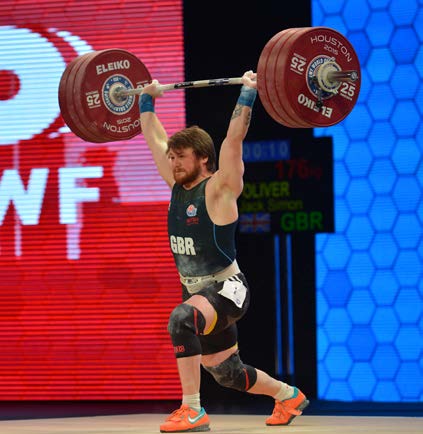
As you punch under, the feet jump into the split: the bar directly above the shoulders, which sit directly above the hips (that stacked line gives you the most support), the front shin vertical, the back heel raised, and the feet about shoulder-width apart — you are not walking a tightrope. Lock the arms and push the head through. Recover by bringing the front foot back first, then the back foot forward, under control, before you lower the bar.
A sensible learning progression
Build the drive and the finish before you chase weight:
- Overhead press → push press → power jerk — layer in the leg drive. The push press in particular teaches you to feel the weight through your heels and keep the dip vertical.
- Jerk balance, and jerks from a rack or blocks — groove the split footwork.
- Behind-the-neck jerk — a great drill for the drive and lockout. See Jerk Behind Neck up close.
Common faults
- Dipping forward onto the toes — throws the bar out in front.
- Pressing the bar out with the arms instead of driving with the legs.
- A short, narrow split that leaves you unbalanced under the bar.
For more fixes, see Trouble-shooting Your Jerk and 3 Top Tips for the Perfect Jerk. Drill the movement light and often — the jerk responds to repetition more than almost any other part of the sport.
Kit tip: The jerk is won on a stable base — a proper weightlifting shoe helps you dip, drive and split with confidence: the Adipowers we wear.
Competition photography: Sarah & Paul Photography — Glasgow 2014 Commonwealth Games.
As an Amazon Associate, Lifting Times earns from qualifying purchases. Some gear links are affiliate links, at no extra cost to you. Learn more.